Plan Your Travel Itinerary Like a Millionaire's Wife

Reading time: 13 minutes
Last week I stood in the concierge area of the Baur au Lac in Zurich and watched a woman organize her entire four-week Asia trip in three sentences. No stressed Googling, no desperate flight comparisons. Just precise instructions, discreet nods, perfect planning. That's how planning a travel itinerary works in upscale circles: efficient, exclusive and without visible effort.
As a woman at the side of a wealthy partner, or in sugar dating, you quickly learn: trips are no longer spontaneous adventures, but strategic compositions of status, discretion and genuine enjoyment. The right planning is what separates a stressed tourist from a woman who is already relaxed in the first-class lounge before the plane even takes off.
Why millionaires' wives travel differently
The fundamental difference starts with mindset. While most people see travel as an escape from everyday life, women in upscale circles see travel as an extension of their lifestyle. It isn't about recovering from something, but about being enriched by something. This perspective changes the entire approach to planning a travel itinerary.
According to a study by Virtuoso, the world's leading luxury travel network, affluent travelers spend on average $8,000 to $15,000 per person on a one-week trip. But budget is only one factor. More decisive is time: wealthy people invest three to six months of lead time for significant trips, to secure access to exclusive events or fully booked restaurants like Eleven Madison Park in New York.
In this context the relationship dynamic becomes visible too. If you're currently clarifying expectations after the first dates, your ability to plan trips thoughtfully signals competence and cultural sophistication. Men in this league value women who don't just come along, but actively contribute to the quality of the experience.
The inspiration phase: where millionaires' wives find their ideas
Forget Pinterest boards with generic beach photos. Real inspiration comes from three specific sources: personal recommendations from the inner circle, exclusive publications and concierge networks.
First, recommendations from women who have already been there count. At a lunch at the Dolder Grand or the Kronenhalle you learn more about a destination than from a hundred blogs. These conversations deliver the truly relevant details: which table at La Pergola in Rome has the best view, which suite at Aman Tokyo guarantees absolute quiet, which personal shopper on Paris's Rue Saint-Honoré understands discreet elegance rather than flashy showiness.
Second, millionaires' wives invest in memberships. Quintessentially, Knightsbridge Circle or Ten Lifestyle Group offer, for $3,000 to $25,000 a year, access to information and booking options that remain closed to the general public. These services curate destinations based on your profile: an art focus for the Venice Biennale, wellness for the SHA Wellness Clinic in Alicante, discreet romance for private villas on Paros.
Third, experienced women use specialized travel magazines like Condé Nast Traveler or Monocle not for the obvious articles, but for the subtle hints in the classifieds and columns. There you find mentions of newly opened boutique hotels in Tuscany or private art tours through Florence, months before they go mainstream.
Concrete sources of inspiration for your next trip
For practical implementation when planning a travel itinerary, I recommend this strategy: start with a theme, not a place. Interested in architecture? Then your route becomes Barcelona-Porto-Lisbon with a focus on modernist buildings. Fascinated by star-level cuisine? Then a tour of Copenhagen-Stockholm-Oslo emerges, with reservations at Noma, Frantzén and Maaemo.
This thematic approach sets upscale travel planning apart from ticking off sights. You travel with purpose, not with a checklist. That also impresses your partner or potential sugar daddy far more than the hundredth "Where would you like to go?"
Detailed planning: timing and booking strategy
This is where the wheat is separated from the chaff. Amateurs book too late, pros too early, millionaires' wives exactly right. The golden rule when planning a travel itinerary: accommodations and signature experiences six to eight months ahead, flights three to four months ahead, local details four weeks ahead.
Why this staggering? Top suites at hotels like the Hôtel du Cap-Eden-Roc on the Côte d'Azur or the Aman Venice are sometimes booked a year in advance, especially during the film festival season in Cannes or during the art biennale. For top-tier restaurants like Osteria Francescana in Modena, reservations open exactly three months ahead. Being too early doesn't help, too late means a waiting list.
For flights a different logic applies. Business and first-class availability fluctuates strongly. According to an analysis by Upgraded Points, the optimal booking time for long-haul flights in premium classes is 90 to 120 days before departure. Here you balance availability against price, whereby the latter is less relevant in upscale circles than preferred time of day and direct connections.
A practical example from my experience: for a two-week trip through Japan I booked in January for September. Ryokans in Kyoto such as the Tawaraya were reserved in February, the three-star restaurant Kikunoi four months ahead, the private tea ceremony master six weeks ahead. This staggering allowed maximum flexibility while securing the non-negotiable elements.
Using the right booking channels
This is where it gets concrete: millionaires' wives never book directly on Booking.com or Expedia. These platforms offer no leverage for upgrades, no direct contacts when problems arise, no recognition of your status.
Instead, three routes work: first, personal relationships with hotel managers, built up over years and maintained through handwritten thank-you notes after every stay. Second, specialized luxury travel advisors like Embark Beyond, Scott Dunn or the Swiss firm Jacada Travel, who receive commissions from the hotel and therefore work for you free of charge, while negotiating upgrades and extras for you at the same time. Third, credit card concierge services from American Express Centurion or Visa Infinite, which secure additional perks on hotel bookings such as breakfast, spa credits or late check-out.
A detail many overlook: always book hotels by phone or email, never via online forms. Direct contact lets you place special requests: a certain pillow firmness, communicating allergies, or the discreet information that this is a trip with your sugar daddy and that you prefer separate names for the booking. This discretion is worth its weight in gold and is appreciated and reciprocated by the staff.
Structuring the itinerary: rhythm instead of rushing
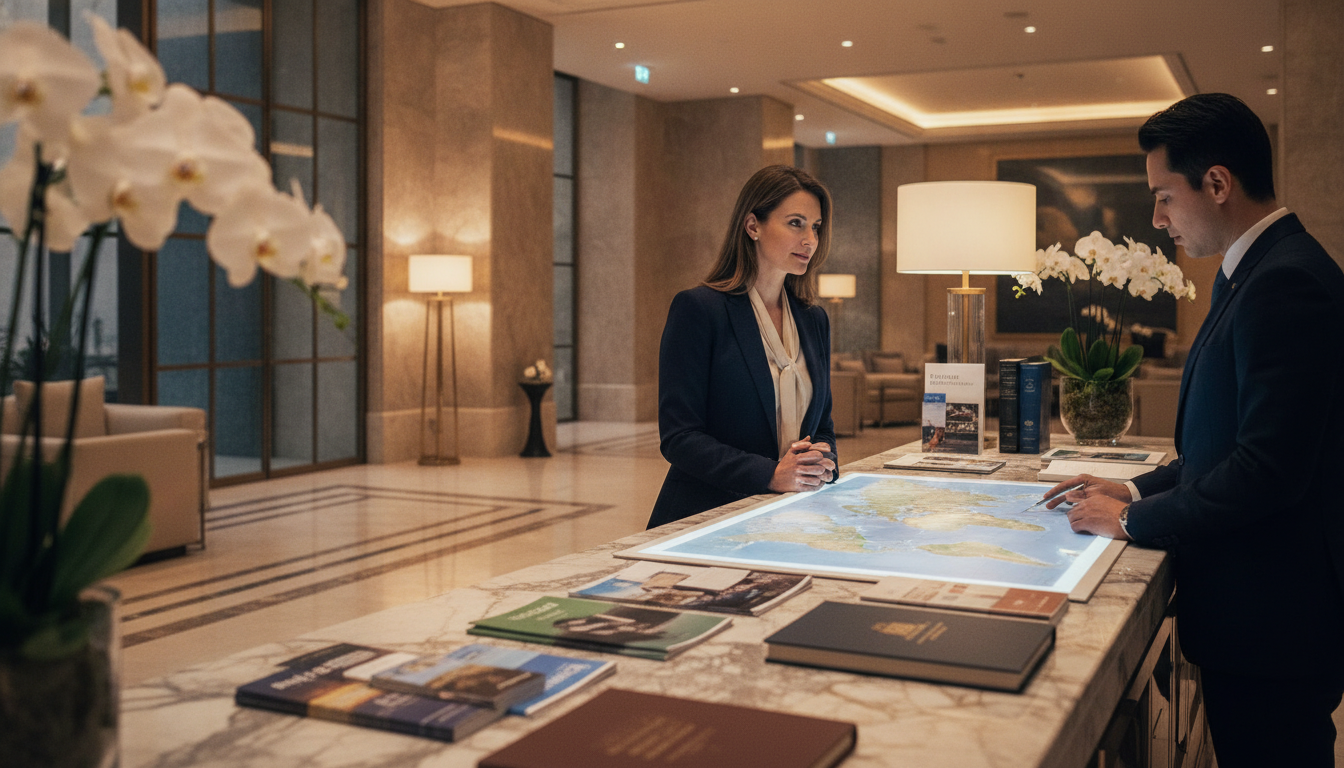
The most common mistake when planning a travel itinerary is overcrowding. I see it again and again: women who want to tick off four cities in five days, rush stressed between airports and end up coming home more exhausted than when they left.
Millionaires' wives understand: luxury means time. A well-planned route has rhythm. The formula is: at most three different accommodations per week, at least two full days per place, one free day per week with no program at all.
Concretely it looks like this: for a ten-day Italy trip you don't choose Rome-Florence-Venice-Milan-Como, but Rome (three nights), a Tuscan villa near Siena (four nights), Venice (three nights). Within this structure you plan intense days with culture and culinary highlights as well as relaxed days at the villa's pool or on a private stroll through less touristy neighborhoods.
This planning also creates room for spontaneity, which paradoxically only becomes possible through good organization. Once the big fixed points are set, you can react flexibly to recommendations you receive on site. The hotel concierge mentions a private art gallery opening tonight? You have the freedom to say yes, because your next fixed appointment isn't until the day after tomorrow.
The daily structure of a perfectly planned trip
- Morning: One cultural or active highlight (museum with a private guide, cooking class in a local villa, yoga session on the beach)
- Midday: A light meal focused on local specialties, ideally in a place with atmosphere rather than hustle
- Afternoon: Personal time for the spa, shopping or simply a good book on the hotel terrace
- Evening: The culinary highlight of the day, followed by a relaxed drink or stroll
This structure prevents overload and creates a real vacation mood. It also signals to your companion that you understand how to truly enjoy luxury, not just consume it. That skill is, by the way, also valuable if you're currently learning to enjoy luxury without showiness.
Mastering logistics and practical details
Now to the often underestimated part: micro-logistics. Millionaires' wives don't travel with an overstuffed suitcase and a lost boarding pass. They have systems.
First, documentation: all reservation confirmations, contact details of hotels and restaurants and important addresses are combined in a single document, ideally in an app like TripIt Pro or in a clear PDF. This document also contains the phone numbers of your credit card's 24-hour concierge services and of your country's embassy in the destination country.
Second, communication: a week before arrival, notify all booked locations once more by email about your arrival. Mention special occasions (birthday, anniversary), confirm dietary requirements and ask for current recommendations for your free time slots. This proactive communication often leads to surprise upgrades or special gestures, because you're perceived as an organized, appreciative guest.
Third, transfers: never book spontaneous taxis at the airport or train station. Arrange private transfers in advance through the hotel or specialized services like Blacklane or Sixt Chauffeur. The surcharge of $50 to $100 compared with a regular taxi is irrelevant compared with the comfort of being greeted by name and getting straight to the hotel without negotiation or searching.
The hidden details that make the difference
What separates a good trip from an extraordinary one? The invisible details. Millionaires' wives know: it isn't the big sights that make a trip unforgettable, but the curated micro-experiences.
Take Paris: everyone knows the Louvre. But how many book a private after-hours tour of the Musée Rodin at sunset, when the tourist crowds are gone and the garden glows in golden light? This experience costs around $500 for two people, lasts 90 minutes and creates a memory that no standard tour could ever match.
Or Kyoto: instead of the crowded bamboo groves in Arashiyama at midday, you arrange access at 6:30 a.m. through your concierge, when only monks and photographers are present. This service exists, but is only offered on request and in return for a "donation" of about 10,000 yen.
You won't find these insider experiences in guidebooks. You get them through targeted questions to local concierges, through memberships in networks like Velocity Black or through personal connections. Planning a travel itinerary becomes the art of curating here.
Budget and financial transparency in relationships
A delicate topic: who pays? In established relationships with wealthy partners the answer is usually clear. In sugar dating or in new arrangements, however, trip planning can also be part of the negotiation, much like in the arrangement conversation.
My recommendation: be transparent from the start. If he suggests the trip, clarify before booking whether he covers all costs or whether you're expected to contribute. This clarity prevents awkward moments at check-out or with the restaurant bill. In most cases with established arrangements, the man covers all travel costs as a matter of course in the relationship.
However: show initiative in the planning, even if you're not paying. Research restaurants, suggest activities, organize the details. These contributions are often valued more highly than financial participation, because they demonstrate engagement and interest.
Using technology smartly

Millionaires' wives aren't averse to technology, but they use it selectively. The following apps and tools have proven themselves:
TripIt Pro for central organization of all bookings, including automatic email import and real-time flight alerts. Cost: 49 dollars a year. Revolut or Wise for payments abroad without exchange-rate markup, especially relevant for pricier restaurant bills. Google Maps with saved lists for every city, curated before the trip with restaurants, shops and sights, so you don't have to keep searching on site.
What millionaires' wives don't use: social media during the trip. Constant posting signals insecurity and a desire for validation. Real elegance shows in the ability to enjoy moments without sharing them immediately. Take photos for yourself, post if at all only after you're back, and then selectively. This discretion is appreciated in upscale circles and also protects your partner's privacy.
Avoiding common mistakes when planning a travel itinerary
From my observation and own experience, these are the five most common mistakes that reveal the difference between amateur and pro:
First, too many destinations in too little time. The "since I'm here anyway" mentality leads to superficial experiences and exhaustion. Quality always beats quantity. Second, missing backup plans. Restaurants can close at short notice, flights can be delayed. Always have a plan B for the most important elements of your trip.
Third, underestimating local customs. In Tokyo absolute punctuality is expected, in Italy rather flexibility. In Dubai strict dress codes apply that are irrelevant in Mykonos. Research cultural expectations, especially dress codes for upscale restaurants. Fourth, insufficient preparation for medical emergencies. A well-stocked travel medicine kit and the number of an international medical service like International SOS belong in every piece of luggage.
Fifth, and most important: not listening to your own intuition. If a hotel looks perfect online but your gut feeling is skeptical, trust your intuition. Often such doubts have a reason that only reveals itself on site.
FAQ: planning a travel itinerary like a millionaire's wife
How far in advance should I plan my luxury trip?
For optimal availability and selection, plan six to eight months ahead. Top hotels and star restaurants often open their reservations in exactly this window. For special events like the Monaco Grand Prix or the Cannes Film Festival, even a year's lead time may be necessary. Shorter-notice bookings are possible but limit your options considerably.
What travel insurance do I need for upscale trips?
Standard travel insurance isn't enough. Invest in premium policies like Allianz Partners Platinum or World Nomads Premium, which cover cancellation costs up to $15,000 per person and include medical treatment in private clinics. Many luxury credit cards like American Express Platinum already offer extensive travel insurance as a card benefit. Check the coverage amounts carefully, especially for trips to the USA, where medical costs can explode.
How do I organize trips with my sugar daddy discreetly?
Discretion starts with the booking. Use separate reservations under your respective names, but with a note for the hotel that you're traveling together and want a one-bedroom suite. Communicate directly with the hotel by email, not through booking platforms. Avoid social media posts during the trip. Pay on site with your own credit card for personal expenses, so that not all transactions run through his account. These details create comfort for both sides.
Which destinations are best for first trips together with wealthy partners?
Choose destinations that combine luxurious infrastructure with cultural offerings: the Côte d'Azur, Tuscany, the Maldives or Dubai. These places offer excellent hotels, Michelin-starred restaurants and enough activities to serve different interests. Avoid extremely remote or adventurous destinations at the beginning, as differing comfort expectations can lead to tension. The trip should strengthen your connection, not test it.
How much initiative should I show in trip planning?
Show clear initiative in research and suggestions, but don't take control unasked. The ideal balance: you present three well-thought-out options with concrete details (hotels, restaurants, activities), he makes the final decision. This dynamic demonstrates your competence without undermining his authority, which is especially important in traditional arrangements with an age gap. Your role is that of a competent co-curator, not a dominant planner.
Conclusion: planning a travel itinerary as a strategic skill
Planning a travel itinerary in upscale circles is far more than a logistical exercise. It is a strategic skill that strengthens your position in the relationship, broadens your cultural horizons and creates real added value. The ability to organize seamless, elegant trips sets apart women who simply tag along from those who actively contribute to the shared lifestyle.
Start with small steps: plan your next trip according to the principles described here. Invest time in research, build relationships with concierges, learn the right booking channels. With every trip you become more competent, and this competence is noticed and appreciated.
The perfectly planned trip is no accident, but the result of foresight, attention to detail and the understanding that true luxury lies in the quality of the experience, not in the number of stamped passports. Now you're ready to plan your next travel itinerary like a true millionaire's wife.